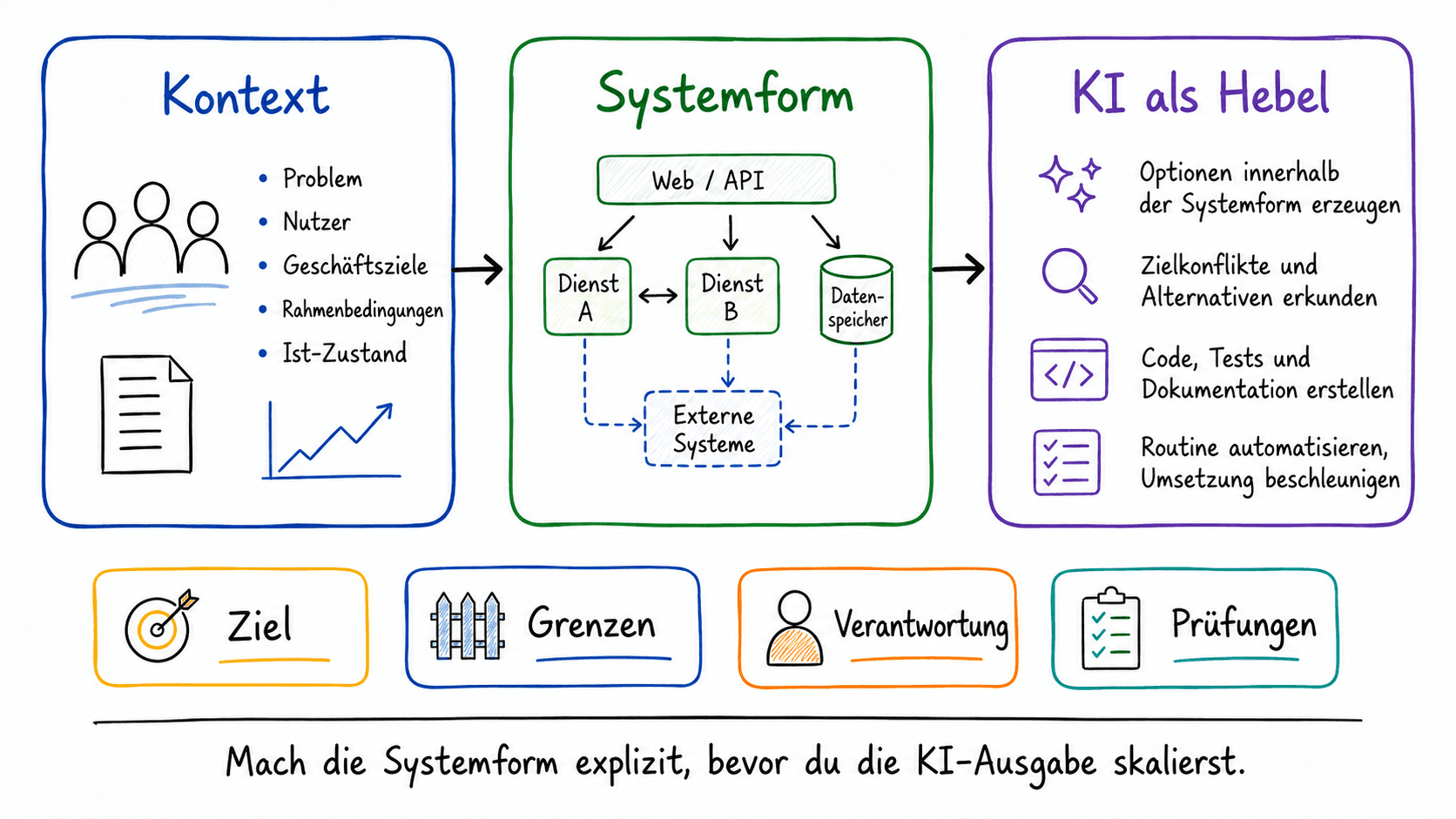
AI makes weak architecture fail faster.
For me, this is one of the more important statements in the current discussion about AI and software development. Not because it sounds particularly dramatic, but because it describes a shift that many teams only notice once a lot of code has already been produced.
AI is an accelerator. That is true.
But that description falls short.
Above all, AI is an amplifier.
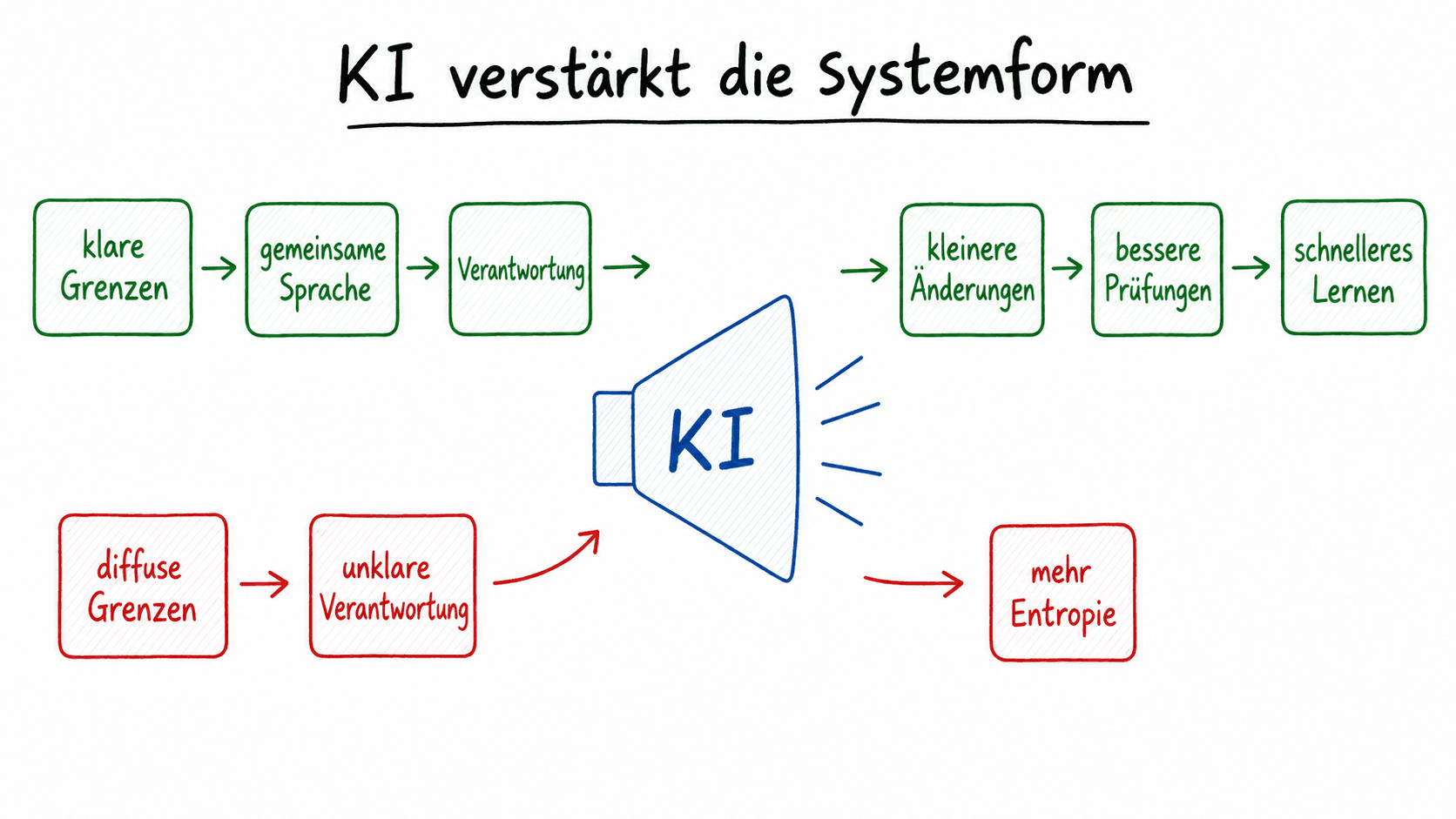
AI does more than accelerate work. It amplifies the system shape that is already there.
When a system has clear boundaries, AI amplifies that clarity. Tasks become easier to scope. Changes stay smaller. Reviews become more concrete. Tests have their place. Domain terms carry more weight. The next step becomes easier to explain because the system already has a recognizable shape.
When a system has weak boundaries, AI amplifies that weakness. More code appears faster in the wrong places. Small local solutions spread through the system. Terms become inconsistent. Responsibilities blur. What previously became confusing slowly now becomes confusing faster.
This point often gets lost in the productivity debate. It is about more than how quickly code can be written. What also matters is the existing system shape that absorbs this speed.
Architecture is system design over time
When I talk about architecture here, I mean more than diagrams, layers or the usual discussion of whether something is a monolith or a distributed system.
Architecture is system design.
It describes which parts carry responsibility. Which boundaries matter. Which terms need to remain stable. Where variation is allowed. Where the system should deliberately stay narrowly scoped. Which decisions need to be made now and which can remain open.
Architecture also describes what a system is being built for.
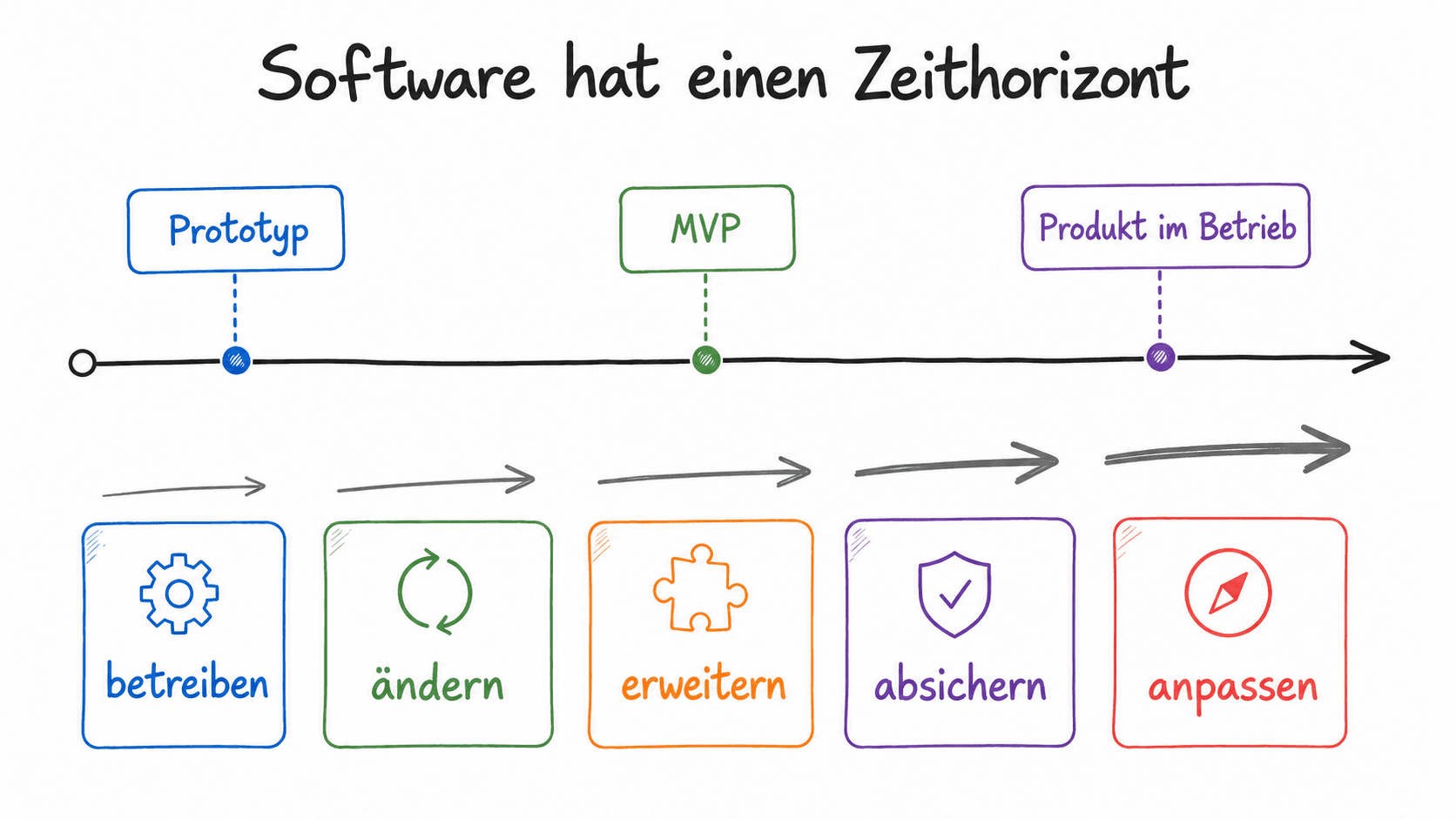
Software is rarely built only for the moment. Sometimes it simply needs to run reliably. Sometimes it needs to grow. Sometimes it needs to adapt to a market. Sometimes it needs to be extended, integrated, secured, operated or handed over to other people.
This time horizon matters.
Software is rarely built only for the moment. It needs to support something over time.
A throwaway script needs a different architecture from a product's core. An internal tool needs different boundaries from a public platform. A prototype can take different risks from a system that processes customer data. An MVP does not yet need the perfect final form, but it needs enough structure to avoid accidentally blocking the next decisions.
When implementation feels cheap
AI shifts this trade-off because implementation suddenly feels cheap.
When an idea can become code in a few minutes, structure can feel like friction. Why spend time on boundaries when the next screen, endpoint, adapter or test can be generated immediately?
This is where the risk begins.
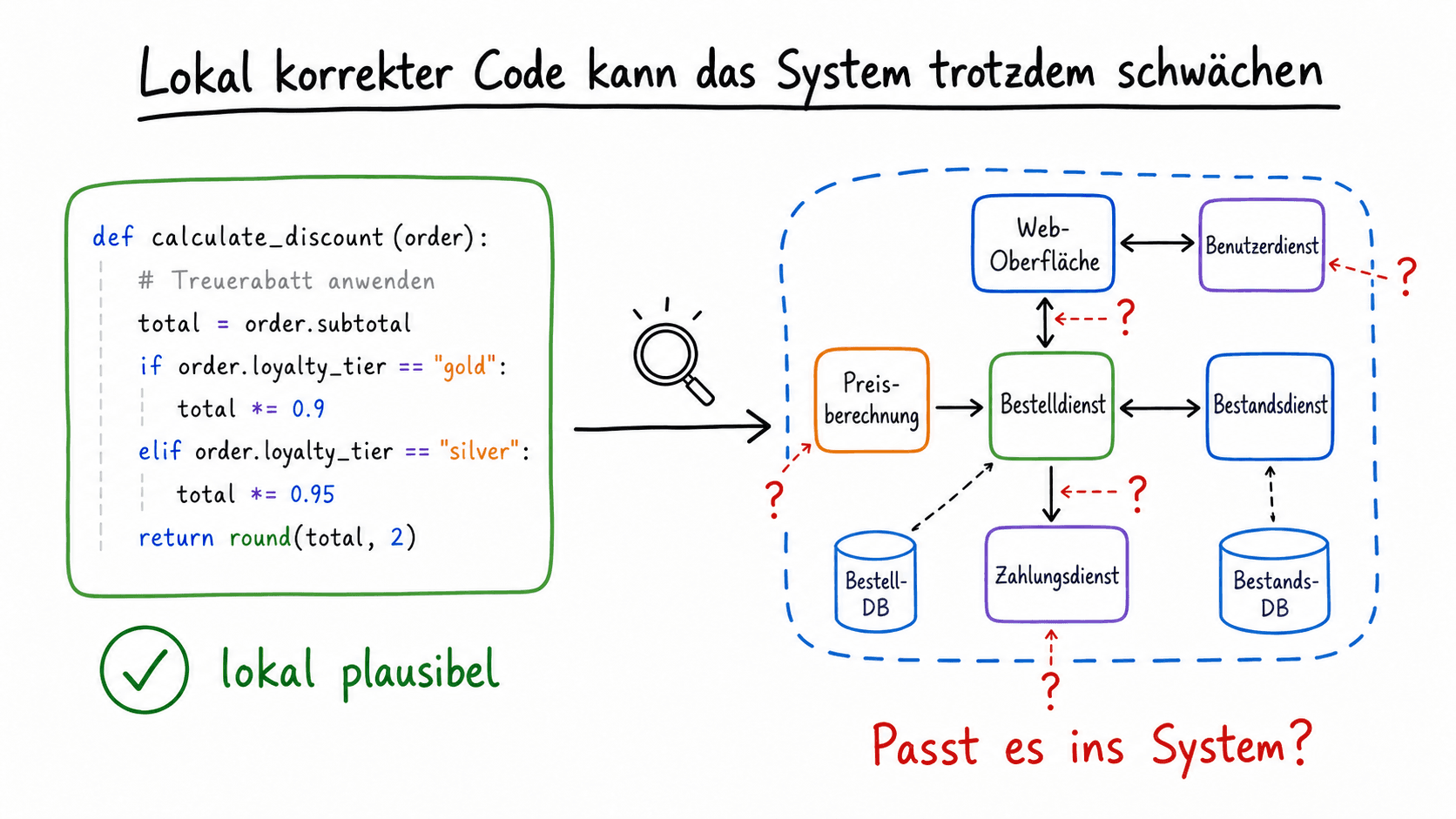
Weak architecture rarely fails because of a single bad commit. It fails because many small decisions pull in different directions. A component takes on a little too much. A service suddenly knows details it should not know. A term is used with three meanings. A technical shortcut becomes a path along which more shortcuts accumulate.
AI can accelerate this process because it is very good at producing plausible local solutions.
Locally plausible solutions are not automatically good system decisions.
Locally plausible code is not automatically a good system decision.
For me, that is the core of it.
An AI assistant can add a function. It can redesign a workflow. It can fix a bug. It can suggest tests. It can pick up an existing pattern and quickly produce more of it.
If the pattern is good, that is useful.
If the pattern is weak, that weakness is multiplied too.
A system with clear modules, clear contracts and clear responsibilities gives AI better guardrails. The context is smaller. The task is more tightly scoped. A review can check whether the change fits the system shape. The team can say: this logic belongs here. This decision stays there. This interface is the boundary. This domain rule must not disappear into the UI.
A system without this shape gives AI too much room for plausible answers.
The assistant then works productively, but that productivity spreads everywhere. It puts code where context happens to be available. It repeats patterns that happen to be visible. It optimizes the next step because the larger framework is unclear.
At first, that feels fast.
Later, it becomes expensive.
Not necessarily because AI writes bad code. Often, the individual code is fine. The problem lies one level higher. The code answers the local question, but the system loses its shape. Architecture problems are not syntax errors viewed from farther away. They are decisions about coupling, changeability, operations, security and domain language.
The architecture question moves forward
That is why architecture does not become less important in AI-assisted development. It becomes visible sooner.
Previously, teams had to invest a lot of energy to produce even a first running version. Today, that first version emerges faster. This brings the real question forward:
What does this system need to support over time?
- Does it only need to test an idea?
- Does it need to run reliably?
- Will several people extend it?
- Will it support external integrations?
- Does it need to respect security, regulatory or organizational boundaries?
- Will it become the product core, or should it deliberately remain a small working tool?
These are architecture questions. They determine what kind of speed is healthy.
A practical moment from projects
A practical example from my own work: when a proof of concept suddenly becomes an MVP candidate, the standards change. At first, a working vertical slice is often enough. A few screens. A workflow. A signal that the idea can work.
As soon as the whole thing needs to live on, other questions arise.
- How will it be operated?
- Where are the security boundaries?
- Which parts may talk directly to each other?
- Which data flows are critical?
- What happens when several people work on it at once?
- Which adapters should remain replaceable?
- Where are clear ports important?
- Which decisions belong in the application, which in the infrastructure and which in a future product core?
AI helps enormously with speed in this situation. But it does not replace the framework.
It even makes missing guardrails more visible. If I can generate ten changes quickly, I need to know even more clearly whether those ten changes lead in the same direction. Otherwise, there is visible progress alongside drift in the system.
That is why architecture is so closely connected with context for me.
Architecture must fit the context
Good architecture is not good in the abstract. It fits. It fits the problem. The lifespan. The risk. The team. The ways the product is likely to change.
AI can help, but it only knows this context as well as we make it explicit.
When context remains diffuse, AI amplifies the ambiguity.
When context is clear, AI amplifies the clarity.
When context remains diffuse, AI amplifies the ambiguity. When context is clear, AI amplifies the clarity.
This changes the role of architecture work. It need not become heavier, larger or more formal. It needs to become more explicit.
- Which boundaries apply?
- Which terms are central?
- Which modules carry which responsibilities?
- Which changes should be easy?
- Which risks are consciously accepted?
- Which parts are prototypes and which form the foundation?
These questions do not all need to end up in a large architecture document. Often, a good system overview, a clear decision list, a few robust tests, clean module boundaries and a team using the same language are enough.
But these answers need to be recorded somewhere.
Otherwise, AI fills the gaps with code.
Make the system shape explicit
This is not a criticism of AI. It is a diagnosis of the work.
When code production becomes cheaper, other activities gain importance: deciding, setting boundaries, naming, scoping, reviewing and placing things in context. This is where architecture belongs.
Using AI productively does not mean skipping architecture work. It means making architecture concrete enough for AI to work within that shape.
Then speed becomes an advantage.
Without that shape, speed becomes faster repetition of existing weaknesses.
AI makes weak architecture fail faster.
That is why fast AI-assisted development needs a stronger system shape early, rather than later.