
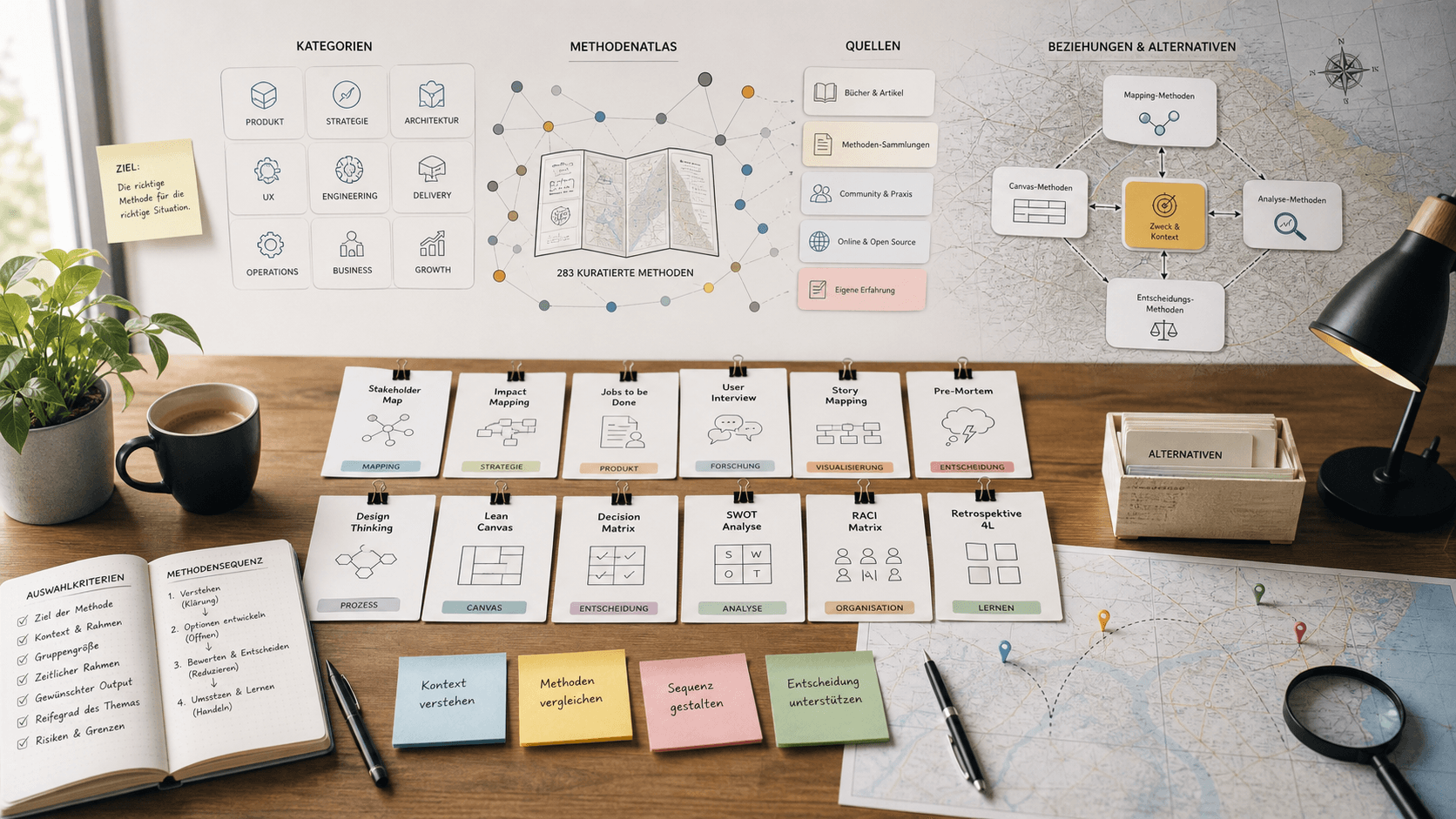
Scattered method knowledge becomes an atlas
At some point, I realized that I did not know too few methods. I had more of the opposite problem. Over the years, small traces of methods had appeared everywhere: in notes, bookmarks, articles, PDFs, workshop materials, product ideas, architectural contexts and somewhere in my head. I had used some methods myself. Others I had seen once, found interesting and later lost again.
That was when Methodatlas became interesting to me. In front of me lay a rich collection of scattered material. I needed to pull it out of its corners, sort it and structure it so it would resurface when I was working.
The atlas did not begin with a feature. It began with a feeling: there is already a lot of knowledge here, but it is not yet within reach.
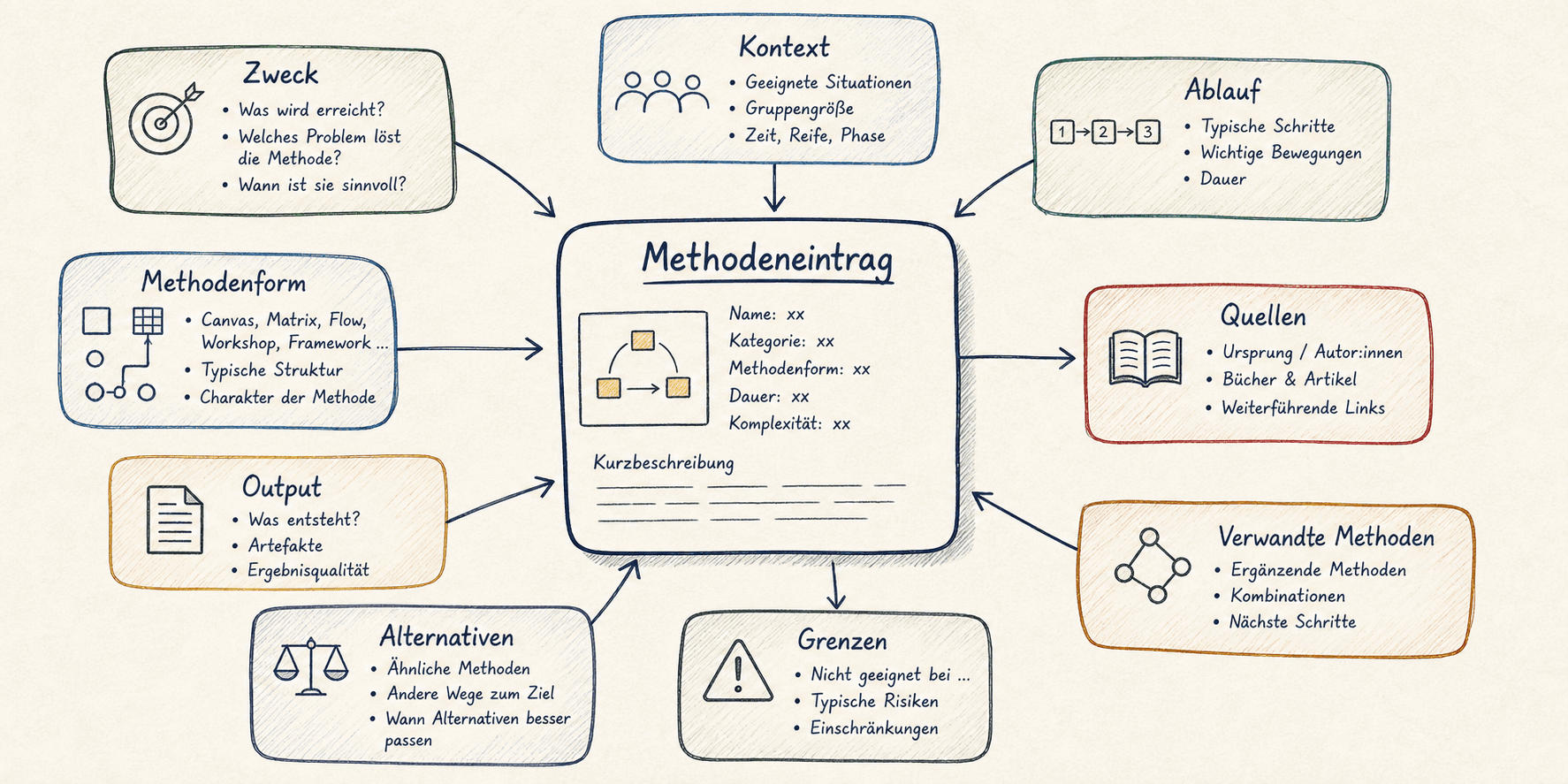
That observation led to the first idea: a central place where methods could be brought back into active use. The atlas was meant to function as a workspace. When I only have a rough recollection, it should provide enough clues: purpose, form, context, output, limitations, alternatives, related methods and visual cues.
The collection became material
At first, it still felt like tidying up. I collected methods I knew, had read about or kept encountering. Some came from product discovery, others from UX, strategy, architecture, delivery, business or operations. Some were very concrete workshop methods. Others were frameworks, mental models, forms of analysis or decision practices.
Then something lovely happened: the list quickly became large enough to feel like material. Ten methods became fifty. Then a hundred. Then two hundred. Suddenly I saw patterns between entries. Some methods were really variants of the same thought process. Some looked similar but addressed different work situations. Some were well known yet difficult to distinguish cleanly. Others were small, underestimated tools that can be incredibly useful at the right moment.
Beyond a certain size, a collection becomes interesting because it reveals its internal structure.
At 283 methods, completeness was no longer my concern. That would be an illusion anyway. The more interesting question was which data model could support this material.
- What information does an entry need to be more than a name?
- What do I need to know to recognize, contextualize, compare and later develop a method further?
The data model became the real work
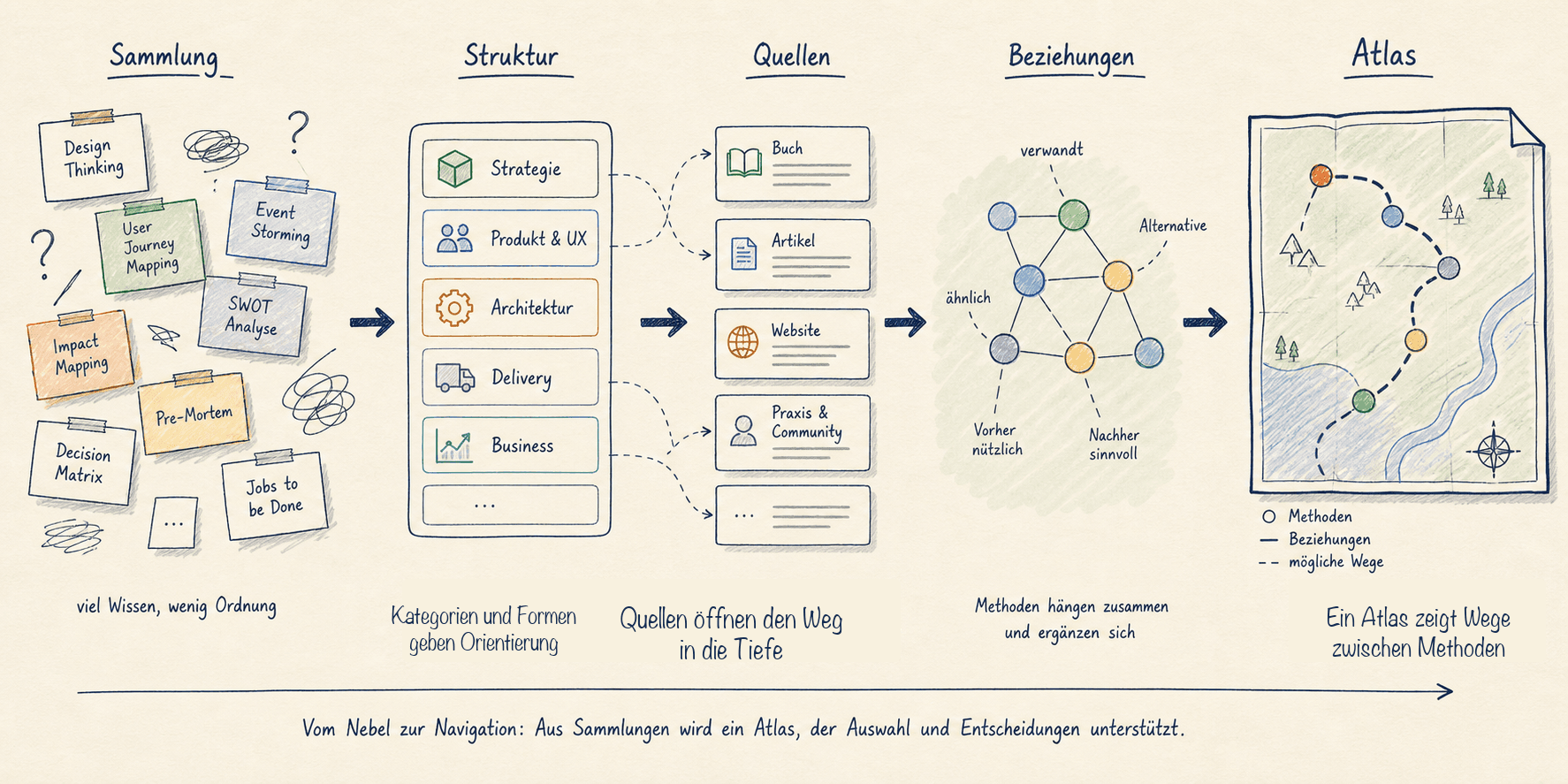
Categories were the obvious first step. Product, UX, strategy, architecture, engineering, delivery, operations, business and growth provide initial orientation. They help scan the catalogue and place a method in its professional context.
But as more entries arrived, it became clearer: the category is only one layer. A method can come from product discovery and still help with strategy work. An architectural method can clarify a product decision. A workshop format can be just right for one team and feel too large for another.
The real breakthrough was method form. Canvas, matrix, flow, workshop method, mapping, scorecard, framework, checklist, decision model. These forms say a great deal about practical use. A canvas invites filling in. A matrix forces distinctions. A flow guides you through steps. A scorecard makes criteria visible. Suddenly the catalogue had a second order that felt much closer to actual work.
With categories and forms, the list slowly became an atlas.
More fields followed: purpose, context of use, output, limitations, tags, related methods and alternatives. That sounds dry, but it was precisely the exciting part of building it. Each new entry was a small test:
- Is the model sufficient?
- Is a dimension missing?
- Does this make the method clearer, or merely longer?
The more methods I entered, the clearer it became which structure really held up.
Sources open the second level
Methodatlas deliberately explains methods briefly. An entry should provide orientation, put a method in context and make the next step easier. In its current state, it cannot replace complete instructions, a textbook chapter or a deep explanation of application.
That is why sources matter. They are the second level behind the short entry. Someone rediscovering a method in the atlas should be able to continue from there to fuller explanations, practical examples, templates, application guidance or original contexts.
The atlas should make a method findable. The sources should help people truly work through it.
This makes curation slower, but also better. A link is useful only when it offers more than the short atlas entry itself. Good sources provide depth, show variants, explain limitations or make practical use more tangible. This lets Methodatlas stay compact while still opening a path into greater depth.
Relationships were the moment it clicked
The next step was relationships. That was where things became really interesting for me. As soon as a method gains alternatives, neighbors and meaningful connections, it stops being an isolated encyclopedia entry. It gains a position in a space.
A method can prepare a decision but may first need problem clarification. Another generates options but needs prioritization afterward. A mapping method makes a system visible but does not automatically lead to action. Such relationships reveal what might come before, beside or after a method.
At that moment, the atlas became spatial: methods sat beneath, beside, before and after one another.
For me, that is the project's real charm. The catalogue is the foundation. Relationships are the step toward navigation. When Methodatlas later starts with context questions, the system can reveal individual methods and plausible paths through a work situation.
Visuals brought the methods to life
The second major moment of insight was the visuals. Text can describe what a method does. But many methods have a visible form of thinking. A matrix looks different from a flow. A canvas creates different expectations from a system model. A timeline guides thinking differently from a scorecard.
When I began building these forms as small SVG orientation aids, the atlas suddenly became much more tangible. A method gained text and a silhouette. You can see more quickly whether it uses fields, steps, axes, roles, decisions, relationships or sequences. The visuals became a shortcut to understanding.
The visuals were the point at which Methodatlas first truly felt like an atlas.
For Methodatlas, this became a field of work in its own right. The visuals should be calm, systematic and comparable. They show the method's form and help with recognition. For me, this contains much of the joy of the project: you build data fields and small maps for thought processes.
What the atlas is today
The current version is deliberately simple. Methodatlas is based on structured data. The web app makes methods searchable, filterable, comparable and visually scannable. Many scattered notes, links, memories and fragments of methods have become an initial coherent interface.
For me, the most important progress lies in the structure. 283 methods are more than a number. They are a testing ground for the model behind them:
- Do the categories hold up?
- Do the forms work?
- Do relationships become visible?
- Do visuals help people grasp things quickly?
- Where are deeper sources missing?
- Which entries are too rough?
- Which methods need better boundaries?
What I want to learn next
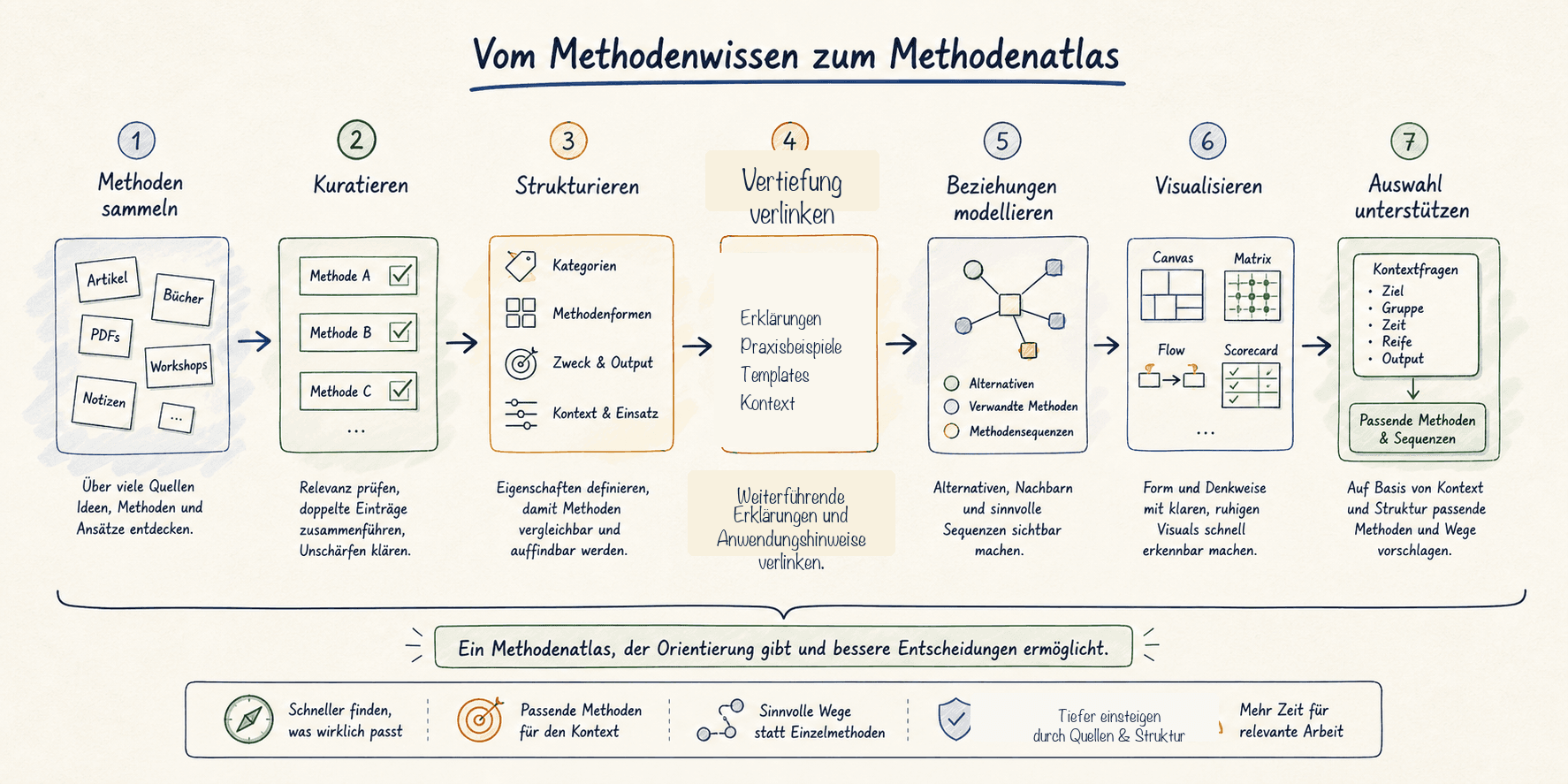
For me, Methodatlas is both a working tool and a learning system. With each entry, it becomes clearer which information really helps and which merely simulates completeness. With each visual orientation aid, it becomes more visible how differently methods actually work. And with each relationship in the catalogue, the question becomes more concrete of how a system can derive a meaningful method selection from context.
This article is the second part of a series about method selection, structured method knowledge and decision support. The first part addressed the problem of method selection. This part covered building the atlas itself: from scattered material, a data model, sources, relationships and visuals. The next part explores why AI can provide strong explanations in method work but needs structured knowledge for good recommendations.
Resource
You can find the current work-in-progress version of Methodatlas here: Open Methodatlas